
Checklist · on this page · about 5 minutes
Resources
Resources.
Practical tools for building a business that works better - for you and the people who help you run it.
Free to read. No sign-up, no email address.

Practical Tools & Checklists
Each tool takes a few minutes and works best if you answer honestly, not hopefully. There’s no score to chase. The point is to notice where the business leans on you, and to pick one thing to change.
Checklist · on this page · about 10 minutes
Is our leadership meeting working?
Open the checklistChecklist · on this page · about 10 minutes
Could the business run while you’re away?
Open the checklistThis one is about the everyday: how much of the normal week runs through you. Read each statement and mark the ones that are true today. Each one you mark is a place where the business leans on you.
- Most decisions above a small amount wait for me.
- Key customers expect to deal with me personally.
- I’m the only one who can price, quote or approve certain work.
- Most of the week’s urgent questions come to me, even ones someone else could answer.
- My team brings me problems more often than proposed solutions.
- Important information lives in my head, my inbox or my phone.
- I review or redo work that others have already finished.
- I set the priorities, and the team waits to hear what they are.
- Hiring, firing and pay decisions all come back to me.
- If I listed who owns each key result in the business, my name would come up most often.
What to do with what you notice
There’s no score. Circle the two you marked that cost you the most time or worry. For each one, ask: who could own this, what would they need to know, and what decisions would they need to be trusted to make? Start with one, and give it a few weeks before judging it. If you’re also planning time away, use “Could the business run while you’re away?” next.
Use this right after your next leadership meeting, ideally with the team. Mark what was true.
- The meeting started and ended on time.
- Everyone knew the agenda before it started.
- We looked at a few key numbers, not just opinions.
- We checked whether last week’s commitments were done.
- Most of the time went to the most important issues, not updates.
- Hard topics were discussed openly, not saved for the hallway afterwards.
- We made decisions instead of just discussing.
- Every action had one owner and a due date.
- Decisions and actions were written down where everyone can see them.
- People left clear on what to tell their own teams.
What to do with what you notice
Pick the two you were least sure about and change one thing before the next meeting. Try ending each meeting by asking everyone to rate it from 1 to 10 and say why. The pattern over a few weeks tells you more than any single meeting.
This one is about preparing for an absence. Imagine you’re away for two weeks and can’t be reached. Mark what’s already true.
- Someone other than me can approve spending up to an agreed limit.
- Each key customer has a second person they know and trust.
- Payroll, bills and invoicing go out without me.
- The team knows who makes the call when something unexpected happens.
- Our most important processes are written down well enough to follow.
- The right people can get into key accounts and systems, securely.
- The team knows this quarter’s priorities without asking me.
- A regular meeting solves problems without me in the room.
- Someone watches the key numbers and knows what to do if one goes off track.
- I’ve agreed in advance what’s worth interrupting me for, and what isn’t.
What to do with what you notice
Anything you didn’t mark is a project, not a failure. Pick one, give it an owner, and test it with a shorter trip first: a long weekend, then a full week. Each time, notice what came back to you, and fix that next.
Recommended Books
Books I recommend to owners and leadership teams, with a note on the situation each one helps with.
The E-Myth RevisitedWhy Most Small Businesses Don’t Work and What to Do About It
- Who Should Read It
- Business owners who are involved in nearly every decision and want to build systems that allow the company to operate without their constant involvement.
- One Question to Consider
- If you stepped away from your business for 30 days, what would stop working?
10x Is Easier Than 2xHow World-Class Entrepreneurs Achieve More by Doing Less
- Who Should Read It
- Owners who want to rethink how they grow their businesses by improving focus, eliminating unnecessary work, and concentrating on their highest-value contributions.
- One Question to Consider
- What would you need to stop doing if your goal were to grow your business tenfold rather than simply improve it?
The Science of ScalingGrow Your Business Bigger and Faster Than You Think Possible
- Who Should Read It
- Entrepreneurs and business leaders looking to break through growth limitations and explore new approaches to scaling their organizations.
- One Question to Consider
- What is the biggest limitation in your current business model that could prevent your company from reaching its next stage of growth?
Good to GreatWhy Some Companies Make the Leap… and Others Don’t
- Who Should Read It
- Owners and leadership teams who want to strengthen leadership, improve strategic discipline, and build a consistently high-performing organization.
- One Question to Consider
- Do you have the right people in the right roles to take your company where you want it to go?
Built to LastSuccessful Habits of Visionary Companies
- Who Should Read It
- Business owners interested in building an enduring company with strong values, a clear purpose, and lasting organizational strength.
- One Question to Consider
- What values and practices should remain unchanged in your company, regardless of how large it becomes?
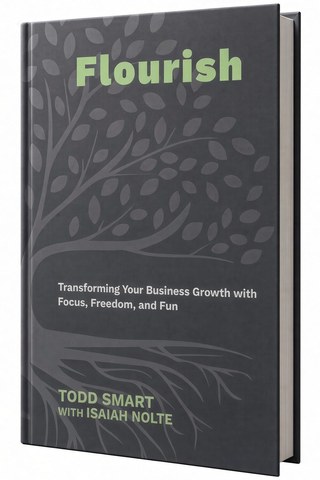
FlourishTransforming Your Business Growth with Focus, Freedom, and Fun
- Who Should Read It
- Owners and leadership teams looking for a practical framework to strengthen their businesses through greater clarity, accountability, healthy teams, and consistent execution.
- One Question to Consider
- Which part of your business needs the most attention today to create lasting improvement?
The Great Game of BusinessThe Only Sensible Way to Run a Company
- Who Should Read It
- Business owners who want employees to understand company finances, take greater ownership of results, and participate more actively in business performance.
- One Question to Consider
- Do your employees understand how the company makes money and how their individual decisions affect its financial performance?
The 7 Habits of Highly Effective People
- Who Should Read It
- Business owners and leaders who want to improve personal effectiveness, prioritization, communication, and relationships.
- One Question to Consider
- Are you spending enough time on what matters most, or is your day being controlled by whatever feels most urgent?
Assessments
Self-assessments that help you see where your business stands today.
Self-assessment · not available yet
How transferable is your business?
The assessment isn’t available to take yet, and no results can be sent.
Read about the Value IndexNoticed something you’d like to talk through? Send me a message.